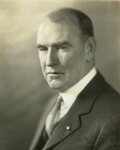
Hamilton Holt (1925-1949)
Files
Description
Journalist, social reformer, and educational innovator, Hamilton Holt left an indelible mark on Rollins College during his 24-year term as the eighth President of Rollins College. He brought with him a national reputation as editor of The Independent, a progressive weekly magazine, and a fervent advocate for peace, civil rights, and democratic ideals.
Born in Brooklyn, New York, in 1872, Holt earned his undergraduate degree from Yale University in 1894 and pursued graduate study at Columbia University. In 1897, he joined The Independent, a publication founded by his grandfather, and rose to editor and owner by 1913. Under his leadership, the magazine merged with Harper’s Weekly and became a powerful voice for progressive causes. Holt used the platform to amplify the lives of ordinary Americans through a pioneering series of personal narratives that became known The Life Stories of Undistinguished Americans (1906). He was also a founding member of the NAACP and remained deeply committed to racial equality and international cooperation.
Holt’s influence extended globally. He participated in the 1907 Hague Peace Conference and the 1919 Paris Peace Conference, strongly supported the League of Nations, and was decorated by multiple foreign governments for his peace efforts. He ran for the U.S. Senate in 1924 as a Democrat but was defeated.
That same year, Holt accepted the presidency of Rollins College, recruited by trustee and author Irving Bacheller. Though lacking formal academic administration experience, Holt brought a bold educational vision rooted in student engagement and faculty mentorship. He implemented the “conference plan,” a student-centered approach emphasizing one-on-one dialogue over traditional lectures. This method limited class size, emphasized teaching over research, and sought to cultivate students' intellectual and personal growth.
Holt elevated Rollins’ national profile by organizing the Rollins Educational Conference in 1931, which hosted philosopher John Dewey, and introducing innovative curricular reforms. He also founded the Animated Magazine, a live annual event that brought national thought leaders to campus. His tenure saw a dramatic expansion of campus life, including architectural shifts to a Spanish Mediterranean style – which dominates campus architecture still today -- and the establishment of enduring cultural organizations on campus like the radio station WPRK and the Rollins Theatre.
Though widely admired, Holt’s presidency was not without controversy. His dismissal of faculty member John Andrew Rice and others over pedagogical and ideological conflicts sparked national debate about academic freedom and contributed to the founding of Black Mountain College. Later, Holt’s progressive values were tested visibly on multiple occasions. In 1947 racial tensions in the local Central Florida community forced the cancellation of a football game that was intended to allow for integrated play. In 1948, Holt clashed with the Board of Trustees over awarding an honorary degree to educator Mary McLeod Bethune, a national leader in higher education. Despite their opposition, Holt ensured the degree was granted as his final act before retiring in 1949—making Rollins the first U.S. college to honor an African American woman in this way.
Despite his public struggles, Holt’s transformative leadership arguably redefined Rollins’ identity and put it on the map as a forward-thinking and top-tier liberal arts institution.
On April 26, 1951, two years after his retirement from Rollins, Holt passed away in Woodstock, Connecticut. To honor his legacy at Rollins, the Board of Trustees established the Hamilton Holt Award, to be given to “the famous or the unknown… It must, however, always be given to those who have in some way shown that any man anywhere, guided by truth and armed with honesty, can find his own destiny.”
First Year of Presidency
1925
Recommended Citation
Rollins College Archives and Special Collections, "Hamilton Holt (1925-1949)" (1925). Rollins Presidents. 10.
https://scholarship.rollins.edu/presidents/10